M42 - Great Orion Nebula
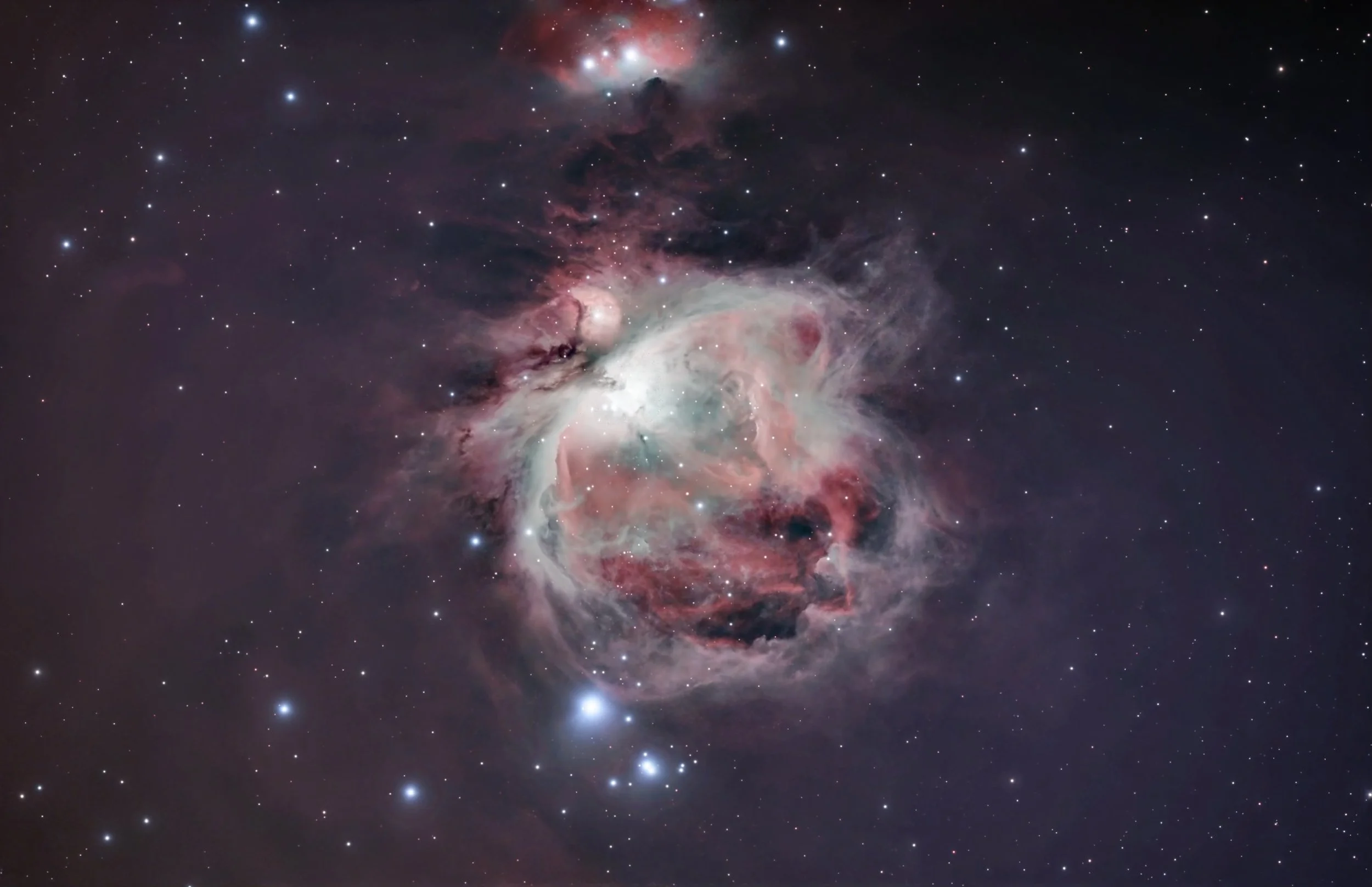
Great Orion Nebula
M42, the Orion Nebula, is one of the most famous and studied deep-sky objects in the night sky. It is a diffuse emission-reflection nebula located in the constellation Orion, just south of Orion’s Belt and visible to the naked eye as a fuzzy patch in the "sword" of Orion. With an apparent magnitude of 4.0, it is one of the brightest nebulae and lies approximately 1,344 light-years (412 parsecs) from Earth, making it the closest region of massive star formation to our solar system.
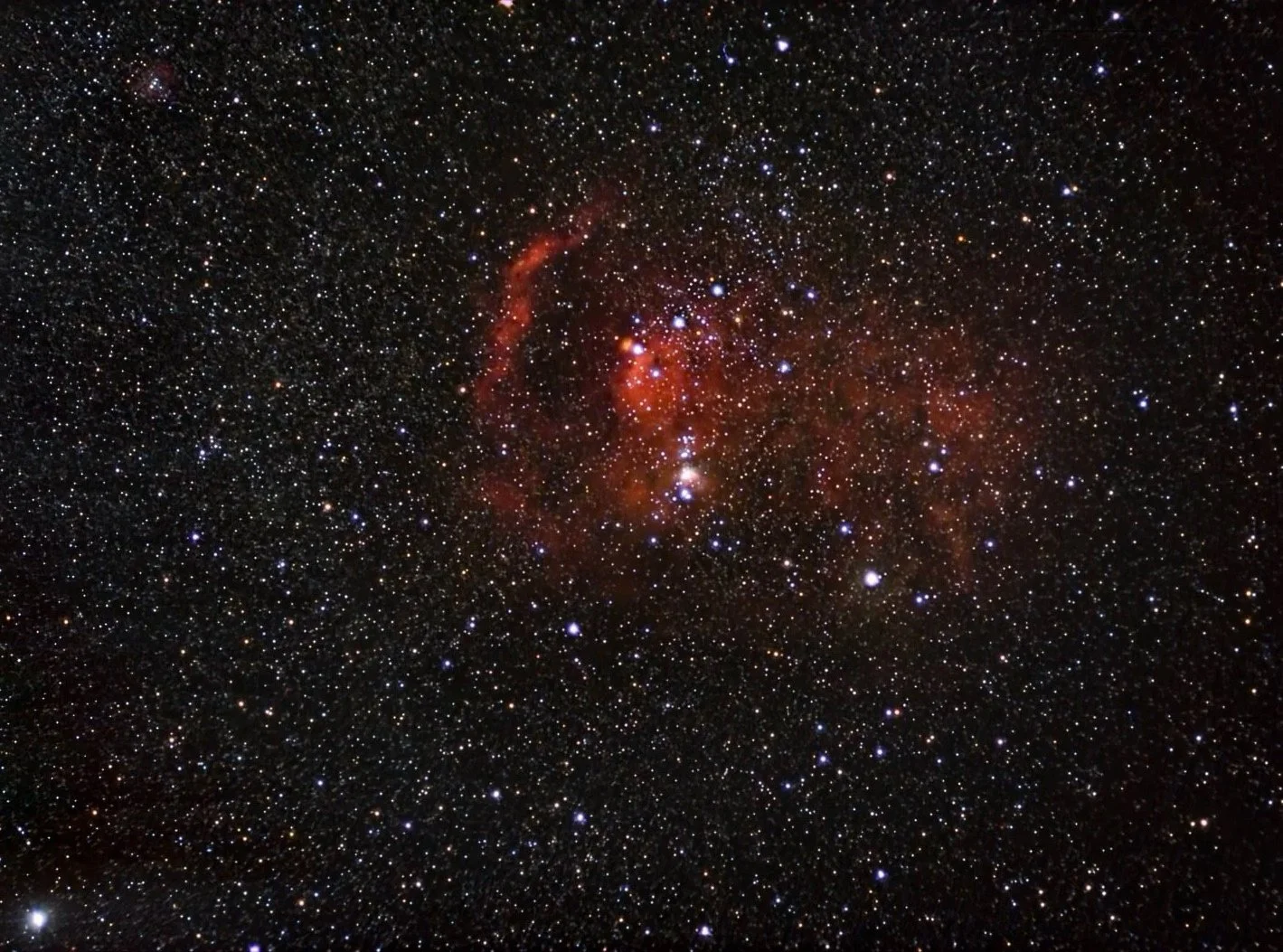
Orion Constellation
M42 can be seen in the middle of this image
The nebula spans about 25 light-years across and contains roughly 2,000 times the mass of the Sun in gas and dust. It is part of the larger Orion Molecular Cloud Complex, which includes other famous nebulae like the Horsehead, Flame, and M43. At its heart lies the Trapezium Cluster, a tight group of young, hot stars that ionize the surrounding gas, causing the nebula’s characteristic red glow from hydrogen (Hα emission) and greenish hue from doubly ionized oxygen.
The Orion Nebula is a stellar nursery, where new stars are actively forming. Observations with telescopes like Hubble and ground-based instruments have revealed protoplanetary disks, turbulent gas motions, and even hidden stars obscured by dust—revealed only through infrared imaging.
Alternative names: Messier 42, NGC 1976, Great Orion Nebula
Best viewing time: January, when Orion is prominent in the night sky
Visibility: Naked eye (in dark skies), easily seen in binoculars and small telescopes
Key features: Trapezium Cluster, "Fish's Mouth" dark void, protoplanetary disks, emission from ionized hydrogen and oxygen